

A jute bag is a woven carrier made from natural plant fibre, built to be used far more than once – which is exactly where its real value, and its real trade-offs, sit. In this guide, we’ll work through what a jute bag is actually made from, how it holds up against plastic in daily use, what the evidence says about its environmental footprint once UK data is applied properly, how UK carrier bag policy has shaped the shift toward bags like this one, how jute compares to its closest rival (cotton), and the practical questions most UK buyers ask before purchasing – recyclability, washing, waterproofing, and cost. By the end, you’ll know exactly where a jute bag fits into your own shopping, gifting, or retail packaging decisions.
A jute bag is made from woven fibre extracted from the jute plant (genus Corchorus), a fast-growing crop that needs comparatively little in the way of fertiliser or pesticide to thrive. The fibre is spun into yarn and woven into a coarse, breathable fabric, then cut and stitched into finished bags.
The fibre itself comes from the inner bark, or “bast,” of the plant stem – not the leaves or seeds – and is obtained through a process called retting, where harvested stems are steeped in water to soften and separate the usable fibre. According to Encyclopaedia Britannica, jute is a bast fibre most commonly sourced from two species, Corchorus capsularis and Corchorus olitorius, and its single largest end use worldwide is in sacks and bags.
Two other terms tend to come up alongside “jute bag,” and it’s worth being precise about them, since they’re often used loosely:
So a “jute bag” and a “hessian bag” are, in practical UK retail terms, the same product described two different ways. The fabric’s plain, open weave is deliberately loose – which is what gives jute bags their characteristic coarse texture and breathability, but also means the finished bag’s weight and density can vary noticeably depending on how tightly it’s been woven and finished.
With the material itself defined, the next practical question is how that woven structure actually performs once it’s carrying real shopping, day after day – which is where jute’s reputation for durability either holds up or doesn’t.

A well-made jute bag can withstand months or years of repeated use, where a standard single-use plastic carrier is engineered for one or two trips and often fails after that. The difference comes down to fibre structure: jute’s coarse, high-tensile weave resists the tearing and puncturing that thin polyethylene film gives way to almost immediately under load.
That said, “durable” isn’t the same as “indestructible,” and it’s worth being specific about where jute’s strength holds and where it doesn’t:
This distinction matters more than it might first appear. It means a jute bag’s durability isn’t a fixed, guaranteed property of the material – it’s conditional on how it’s built and how it’s treated. And that conditionality is exactly why “jute is more durable than plastic” isn’t, on its own, a complete environmental argument. Durability only translates into a genuine environmental benefit if the bag is actually reused enough times to offset what it took to make it in the first place – which is a question the UK’s own environmental research has looked at directly.

It depends almost entirely on how many times the bag gets reused – not on the material itself. A jute bag left in a drawer after one shopping trip can have a higher environmental footprint than the plastic bag it was meant to replace, because more resources go into producing it upfront.
This is worth stating plainly because it cuts against the intuitive assumption that “natural fibre = automatically greener.” The UK’s most detailed government research on this exact question, the Environment Agency’s 2011 life cycle assessment of supermarket carrier bags, found that reusable bags have to be used a specific minimum number of times before their global warming potential drops below that of a single conventional HDPE plastic bag:
The study didn’t isolate jute as a separate category, so it would be inaccurate to quote a specific “jute reuse number” as if it were part of that dataset. But jute is a woven natural fibre bag with a broadly comparable manufacturing profile to cotton, which makes cotton’s 131-reuse threshold the closest and most honest UK-government-backed benchmark available for what a natural-fibre bag needs to achieve before it’s genuinely outperforming plastic on climate impact.
More recent research reinforces why this threshold matters. A 2025 life cycle comparison found that a single-use jute bag’s production carbon footprint runs to roughly 313 grams of CO2-equivalent, compared with around 57 grams for a single plastic bag – a fivefold difference for one bag against one bag. The conclusion the researchers draw isn’t “jute is worse than plastic”; it’s that jute’s environmental case rests entirely on sustained reuse, since a bag with a higher manufacturing footprint needs proportionally more trips to break even.
So the honest summary is this: jute bags can be meaningfully better for the environment than plastic – but only when they’re actually treated as a long-term, repeated-use item rather than a one-off. That reuse behaviour isn’t just a personal choice, either. It’s exactly the shift UK carrier bag policy has been designed to encourage since 2015, which is where the national data becomes directly relevant.

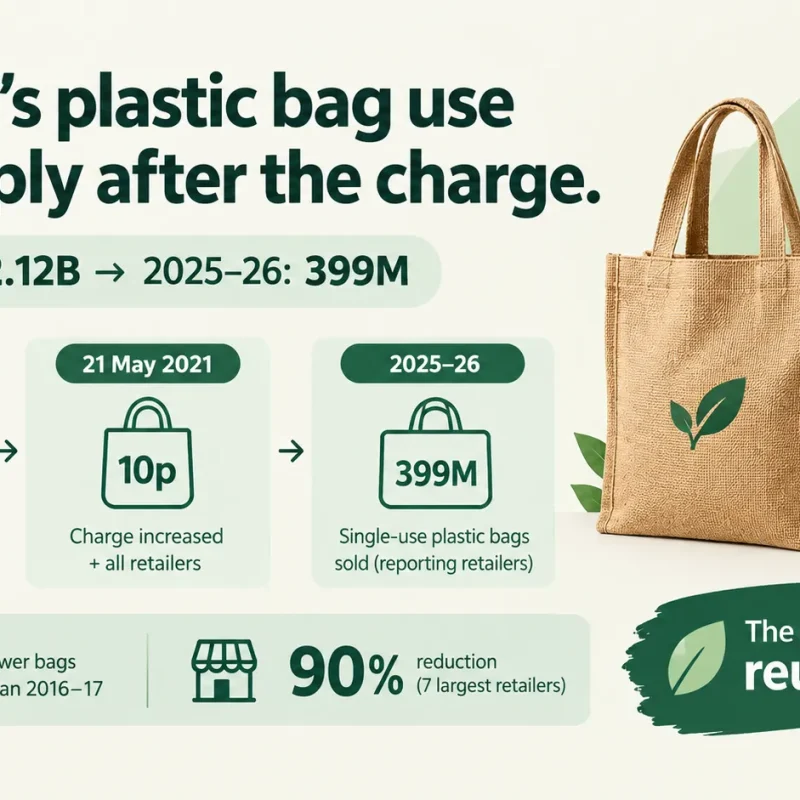
England’s carrier bag charge has driven one of the most measurable behaviour shifts in UK retail history, cutting the number of single-use plastic bags sold by major retailers by roughly 90% since reporting began. That scale of change is exactly why reusable natural-fibre bags – jute included – have moved from a niche choice to a mainstream one.
The policy’s timeline is worth knowing because it explains the pace of that shift:
The most recent government data, published by Defra for the 2025–26 reporting year, shows England’s reporting retailers sold 399 million single-use plastic bags – down 9% year-on-year and down 81% since 2016/17, the first full year of reporting. Among the seven largest retailers specifically, sales fell to 126 million bags, a 90% drop since 2016/17, equivalent to roughly two single-use plastic bags per person across the year.
It’s worth being balanced here rather than cherry-picking the most flattering figures: the 2024–25 reporting year actually saw a 7% year-on-year increase, to 437 million bags, before the following year’s data resumed its downward trend. Progress hasn’t been perfectly linear – but the multi-year direction is unambiguous, and the underlying incentive for shoppers and retailers alike has stayed the same: pay repeatedly for single-use plastic, or invest once in something built to be reused.
If your business is already navigating this shift – sourcing bags that customers will actually reuse rather than throw away – our Retail Shopping collection is built around exactly that brief for UK shops looking for a durable, checkout-ready alternative to single-use plastic.
That policy backdrop explains why reusable bags have become the default expectation in UK retail. The next practical question is which reusable material actually makes sense for a given use case – and the comparison shoppers and buyers ask about most often is jute against its closest natural-fibre rival, cotton.

Jute and cotton are both natural, biodegradable, reusable fibres, but they diverge sharply on two practical points: what it costs the environment to grow them, and what they look and feel like once they’re a finished bag. Neither material is a straightforward “better” choice – it depends on what the bag needs to do.
Growing input. Cotton is a genuinely water-intensive crop. Widely cited Water Footprint Network research puts the global average water footprint of cotton fabric at close to 10,000 litres per kilogram, with figures for some producing regions running considerably higher. Jute, by contrast, is a rain-fed monsoon crop that’s traditionally grown with comparatively low fertiliser and pesticide input – which is part of why it has a reputation as one of the lower-impact natural fibres to cultivate, even though a direct, UK-government-verified water-footprint figure specifically for jute isn’t publicly available in the same standardised format as the cotton research.
Finish and feel. Cotton’s finer, softer fibre takes dye and print far more cleanly than jute’s coarse weave, which is why cotton totes are the default choice when sharp, detailed branding matters. Jute’s texture is coarser and its natural colour tends to dominate, giving it a more rustic, visibly “natural” look that some retailers use deliberately as a design cue for eco-positioned products.
Cost. Jute is generally the cheaper of the two fibres to produce, largely because it requires fewer agricultural inputs and is faster to cultivate.
Because of this trade-off, a growing number of UK and international suppliers now offer juco – a jute-cotton blend that aims to combine jute’s lower input cost with cotton’s smoother, print-friendly surface. It’s a reasonable middle ground where a business wants a natural-fibre bag that still prints cleanly without paying full cotton pricing throughout.
With the two main natural-fibre materials compared, the next set of questions moves from “which material” to “what happens to this bag at the end of its life” – starting with the two questions UK buyers ask most often: is it recyclable, and does it actually biodegrade.

Untreated jute is fully biodegradable and will break down naturally in the right conditions – a genuine advantage over plastic, which persists in the environment for decades. Recyclability, however, isn’t automatic: it depends entirely on how the bag has been finished.
Biodegradability. As a plant-based bast fibre, plain, undyed or naturally dyed jute breaks down through normal microbial decomposition once discarded, in a matter of months to a couple of years depending on conditions – a sharp contrast to conventional plastics, which Britannica notes are produced from entirely different, non-renewable feedstocks with none of that natural breakdown pathway.
What disqualifies a jute bag from composting or standard recycling – and this is the detail most guidance skips over:
In practice, this means the label “jute bag” covers a spread of end-of-life outcomes, not one single answer. A plain, unlined, undyed jute bag is genuinely compostable. A laminated, heavily printed jute tote for retail branding is not – and shouldn’t go in a home compost bin or standard kerbside recycling stream, regardless of how “natural” the base material is.
Knowing what happens to a jute bag at the end of its life naturally raises the question of how to look after it during that life – because a bag that’s washed or stored incorrectly won’t reach the reuse count needed to justify its footprint in the first place.
Most jute bags should be spot-cleaned or briefly hand-washed rather than put through a washing machine, because prolonged soaking weakens the natural fibre and can cause shrinkage, colour bleed, or fraying at the seams. Air-drying away from direct heat is the safest way to preserve both shape and structural integrity.
A few practical points worth knowing:
These are general guidelines rather than a full step-by-step process – for a more detailed care routine covering specific stain types and storage tips, our dedicated guide on how to clean a jute bag walks through the full method in more depth.
One care question comes up more than almost any other for UK shoppers specifically, given the climate they’re buying for – and it deserves a direct, unambiguous answer rather than a vague one.
No – untreated jute is not waterproof. As a natural fibre, it absorbs moisture on contact, which makes plain jute a poor choice for genuinely wet UK weather or for carrying anything liquid-heavy without some form of protection.
This is a functional limitation worth taking seriously rather than glossing over, because it directly affects what a jute bag is fit for:
The practical guidance is straightforward: choose a laminated jute bag for regular grocery shopping or anything likely to encounter British rain, and reserve plain, untreated jute for gifting, retail packaging, or merchandising use, where moisture exposure is far less of a concern and full biodegradability is the more valuable property.
With the material, durability, environmental trade-offs, UK policy context, cotton comparison, and care requirements all covered, the last practical step is bringing this back to a straightforward buying decision – what jute bags typically cost, and what they’re actually best suited for.
Plain jute bags are inexpensive relative to how long they last, with the price climbing as extras are added – printing, lamination, reinforced handles, or a cotton-blend (juco) finish for a smoother surface. In the UK, jute bags show up most often in four fairly distinct use cases, each with a different priority.
If your own sourcing need sits closer to any of these use cases but on the paper side rather than jute specifically, it’s worth knowing what’s already available. For branded events, conferences, or corporate giveaways, our Corporate and Events collection is built around exactly that reuse-and-branding logic. For retailers weighing up their own checkout bag strategy against the same durability and cost-per-use questions covered above, the Retail Shopping collection is the direct paper-based equivalent. And if you’re planning ahead for seasonal packaging, our Christmas collection covers the same “durable, natural-look, gift-ready” brief many buyers reach for jute to solve.
The evidence points to one consistent conclusion: jute bags are genuinely durable and, in their untreated form, genuinely biodegradable – but neither property does anything for the environment unless the bag is actually reused, repeatedly, rather than treated as a slightly nicer single-use bag. That’s not a minor caveat; it’s the entire basis on which jute’s environmental case stands or falls, as both the UK Environment Agency’s reuse-threshold research and more recent carbon footprint comparisons make clear. It also lines up with the direction UK policy has been pushing since 2015 – away from disposability and toward bags built to last, whatever material they’re made from. If you’re weighing up jute against the practical alternatives for your own shopping, gifting, or retail needs, the collections linked throughout this guide are a reasonable next stop for comparing what’s actually available in the UK market today.