
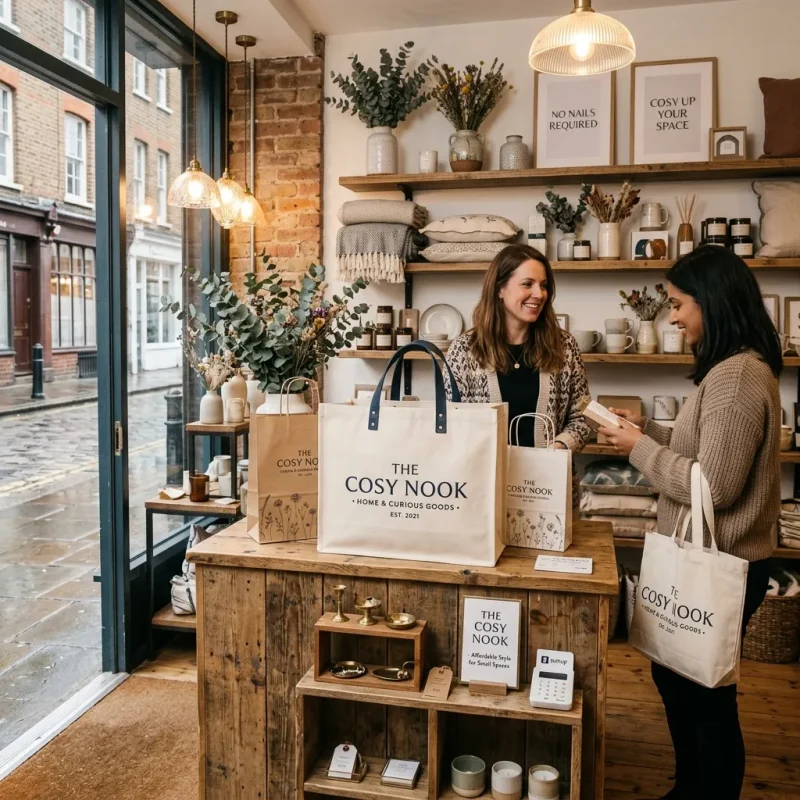

A canvas shopping bag is a reusable carrier bag made from woven cotton fabric, designed to replace single-use plastic bags for groceries and everyday shopping. It’s durable and reusable by design – but it is not automatically the “greener” choice: UK government-commissioned research has found that a cotton canvas bag needs to be reused 131 times before its environmental impact drops below that of a single lightweight plastic bag. Whether a canvas bag is genuinely the right choice depends on how it’s made, how often you’ll actually use it, and what you’re comparing it against – which is exactly what this guide breaks down.
A canvas shopping bag is built from tightly woven cotton fabric – typically plain cotton canvas, organic cotton canvas, or a cotton-jute blend – engineered to carry weight repeatedly rather than for a single trip. That construction is what separates a “canvas shopping bag” from a “cotton tote”: a tote is often a lighter, fashion-oriented accessory bag, while a shopping bag is usually reinforced with a flat or gusseted base, double-stitched handles, and a boxier shape designed to stand upright and hold groceries or retail purchases without collapsing.
Fabric weight is the main indicator of durability, measured in GSM (grams per square metre):
Construction details matter as much as the fabric itself. A gusseted base (a flat, boxed bottom rather than a simple flat pouch shape) lets the bag stand on its own and distributes weight more evenly, which matters directly for how long the bag survives – a detail we’ll come back to when looking at realistic lifespan later in this guide. Reinforced or bar-tacked handle stitching is the other common point of failure, and it’s usually the first thing to give out before the fabric itself wears through.
Understanding this construction matters before comparing canvas to anything else, because a thin, unreinforced 100 GSM canvas bag and a heavyweight 300+ GSM one behave completely differently in terms of both durability and environmental payback – a distinction most buying guides skip entirely.
Next, it’s worth understanding why canvas bags became a default option for UK shoppers in the first place, since that context shapes how they’re actually used in practice.
Canvas and other reusable bags became a fixture of UK shopping largely because of policy, not preference. England introduced a 5p charge on single-use plastic carrier bags at large retailers on 5 October 2015. In 2021, the charge doubled to 10p and was extended to businesses of all sizes, not just large retailers. That single change did more to normalise reusable bags – canvas, jute, and heavier “bags for life” alike – than any marketing campaign, because it made bringing your own bag the cheaper habit by default.
The effect on single-use bag numbers has been substantial, though it’s worth reading the most recent figures rather than older headline stats, since the reporting base has changed over the years. According to Defra’s official 2024–2025 data, the 102 large retailers reporting for that period sold 437 million single-use plastic bags – around 8 bags per person – a figure that is 7% higher than the year before but still 79% lower than in 2016/17, the first full year the charge was in force.
Alongside that shift in single-use bag sales, ownership of reusable bags has become close to universal. WRAP’s 2021 research found that 94% of UK adults now own a reusable bag of some kind – cotton, jute, or heavier woven plastic.
That’s an important distinction to hold onto: the carrier bag charge changed what people carry out of the shop, but it didn’t specify which reusable material they’d choose, or how many times they’d actually reuse it. Those two questions – material and reuse frequency – are what actually determine whether swapping to a canvas bag reduces or increases environmental impact, and that’s where the picture gets more specific than most shoppers realise.

The most rigorous UK data on this question comes from the Environment Agency’s Life Cycle Assessment of Supermarket Carrier Bags (Report SC030148), which measured the manufacturing, transport, and disposal impacts of seven bag types and calculated how many times each would need to be reused to match the global warming potential of a single lightweight HDPE plastic bag used once.
The results:
| Bag type | Reuses needed vs. an HDPE bag with no secondary reuse | Reuses needed vs. an HDPE bag reused as a bin liner |
| Paper bag | 3 | 7 |
| LDPE plastic “bag for life” | 4 | 9 |
| Non-woven polypropylene (“fabric” bag for life) | 11 | 26 |
| Cotton/canvas bag | 131 | 327 |
The reason canvas sits so far above every other option comes down to what goes into producing the fabric: cotton cultivation is water- and land-intensive, and weaving cotton into canvas is more energy-intensive than manufacturing thin plastic film or paper. A canvas bag starts its life with a significantly larger environmental “debt” than a paper or plastic equivalent, and only pays that debt down through heavy, sustained reuse.
This isn’t a UK-only finding, either. A separate 2018 study by the Danish Environmental Protection Agency modelled the same question across a wider set of environmental indicators – not just carbon – and found cotton bags need around 52 reuses on climate impact alone, rising to roughly 7,100 reuses once water use, land use, and other factors are weighted in. The exact number moves depending on what you’re measuring, but every serious study agrees on the same underlying pattern: cotton canvas is the highest-impact material to produce, and it only becomes the lowest-impact option to use after a genuinely large number of reuses.
The practical takeaway: if you’re honest about how often a bag will actually get reused, a well-made paper carrier bag reaching break-even at just 3–7 uses is a far easier bar to clear than a canvas bag’s 131. This is exactly the calculation that leads many retailers to default to paper carrier bags rather than canvas for day-to-day transactions – customers don’t reliably bring the same bag back dozens of times, and a lower break-even point means the bag is more likely to have a net positive impact by the time it’s actually retired. If you’re sourcing carrier bags for a shop, event, or retail counter with that same reasoning in mind, our Retail Shopping collection is built around exactly this use case.
Reuse count is clearly the variable that decides everything here – so the next question is how realistic 131 uses actually is for an average canvas bag, and what determines whether it gets there at all.

Reaching the 131-use break-even point depends entirely on how the bag is built and how it’s treated – a thin, unreinforced canvas bag and a heavyweight, gusseted one are not on the same trajectory at all.
Typical lifespan by usage pattern:
The most common failure points, in order of how often they actually cause a bag to be retired:
This is also where the gap between the “bags for life” promise and how people actually use reusable bags becomes relevant. Greenpeace and the Environmental Investigation Agency’s Checking Out on Plastic II report found UK supermarkets distributed roughly 1.5 billion plastic “bags for life” in a single year – equivalent to around 54–57 bags per household – a figure that only makes sense if most of those bags are being discarded and replaced far sooner than “for life” implies. The material matters less than the pattern: whether it’s canvas, cotton, or heavy-duty plastic, a reusable bag only delivers its environmental benefit if it’s actually reused anywhere close to its intended lifespan, rather than becoming a slightly sturdier single-use bag with better branding.
That reuse-versus-replacement pattern has a direct financial dimension too, particularly for anyone deciding what to buy – or what to hand out – at scale, which is where cost comes in next.
UK retail prices for canvas shopping bags typically fall into a few clear bands:
The main cost drivers are fabric weight (GSM), construction (a gusseted, reinforced base costs more to produce than a flat pouch shape), and print method – screen printing is economical at volume but has a fixed setup cost per design, while full-colour or multi-position printing adds cost regardless of quantity.
For a business, the more useful number isn’t the unit price – it’s the cost per use. A £2.50 canvas bag that’s genuinely reused 131 times to break even environmentally, and used well beyond that to be cost-effective, works out to a few pence per use. But that maths only holds if the bag is actually reused at that scale. For a retailer handing a bag to a customer once, at the point of a single purchase, the honest cost-per-use is simply the full purchase price – because there’s no guarantee, and often no realistic expectation, that the same customer brings that exact bag back for a second, tenth, or hundredth transaction.
That distinction – a bag you expect one customer to reuse personally, versus a bag you’re handing out once per transaction – is the same distinction that determines whether canvas makes commercial sense for a given business, which is the focus of the next section.
Canvas bags can work well as a retail or branding tool, but the business case depends heavily on how the bag will actually be used by the customer who receives it.
Where canvas tends to make sense:
Where it tends not to make sense:
Branding considerations also differ from paper: canvas is typically screen-printed, which is cost-effective at higher volumes but carries a fixed setup cost per design and colour, and usually involves longer lead times than printing onto paper stock. Minimum order quantities for custom canvas bags are also often higher than for printed paper bags, which matters for smaller retailers testing a new design or running a seasonal promotion rather than committing to a large, standing order.
Set against the reuse-count data from earlier in this guide, the comparison for a typical retail counter is fairly direct: a paper carrier bag reaches its environmental break-even point at just 3–7 uses and carries a lower unit cost and lower MOQ, making it the more practical default for a bag that’s handed out with every transaction. Canvas earns its higher upfront cost and environmental debt back only when the retailer can reasonably expect the same bag to be reused by the same customer dozens of times over – which fits boutique and gifting contexts far more naturally than a high-turnover shop counter.
If you’re weighing that decision for your own business, our Retail Shop ping collection is built for exactly the transactional, per-purchase carrier bag use case, our Twist Handle Bags range covers the everyday carrier bag alternative in a range of colours and sizes, and our Boutique Bags range is the closer equivalent for businesses specifically after that premium, “worth keeping” bag experience canvas is often chosen for.
For shoppers rather than retailers, though, the goal isn’t choosing the right bag to hand out – it’s getting real value out of the one you already own, which comes down to how well it’s looked after.

Since the entire environmental case for canvas depends on heavy reuse, basic care is what actually determines whether a bag gets anywhere near its break-even point.
None of this is complicated, but it’s the difference between a canvas bag that quietly reaches – or exceeds – its 131-use break-even point, and one that’s mildewed, torn, or replaced within a year, at which point it has simply become a higher-impact bag that was thrown away sooner than a paper one would have been.
With care covered, the last practical question is simply where UK shoppers typically source these bags from.
Canvas shopping bags are widely available across UK retail, and the buying options generally split into a few categories:
This guide has intentionally stayed neutral on specific canvas retailers, since our focus – and our own product range – is on the paper side of this comparison. If what you actually need is a cost-effective, fully recyclable carrier bag for your shop, gift line, or event, rather than a canvas tote, it’s worth weighing it against the data earlier in this guide: our Retail Shopping collection is designed for exactly that lower-break-even, per-transaction use case.
Buying the right bag is only half the picture, though – it’s also worth understanding the regulatory backdrop that shapes why reusable bags are so widely available and expected in UK shops in the first place.
The rule most shoppers actually encounter is the single-use plastic carrier bag charge: 5p per bag at large retailers from 5 October 2015, raised to 10p and extended to businesses of all sizes from 21 May 2021. It’s a charge, not a ban – retailers are still permitted to sell single-use plastic carrier bags, provided the required amount is charged and, for large retailers, reported to Defra.
It’s worth being precise about what this charge does and doesn’t cover, since it’s often conflated with separate UK single-use plastics restrictions (such as bans on single-use plastic cutlery, plates, and certain polystyrene food containers) – those are different pieces of legislation targeting different products, not an extension of the carrier bag charge itself. For carrier bags specifically, the charge remains the operative rule, and it applies equally regardless of whether the reusable alternative a shopper switches to is canvas, jute, paper, or heavier-duty plastic.
With the cost, durability, care, and regulatory picture all covered, the last useful step is pulling it together into a straightforward way to decide.
Only after significant reuse. The Environment Agency’s Life Cycle Assessment found a canvas bag needs to be reused 131 times to match the carbon footprint of a single lightweight plastic bag (327 times if that plastic bag would otherwise have been reused as a bin liner). Used only a handful of times, a canvas bag typically has a higher environmental impact than a plastic or paper bag.
Cotton canvas is biodegradable and can be recycled through textile recycling schemes in the same way as other cotton fabric, but it generally isn’t accepted in standard kerbside paper or plastic recycling collections. Check with your local council or a textile recycling point for the correct route.
This varies by construction, but a well-made mid-to-heavyweight canvas bag with reinforced handles and a gusseted base is typically built to carry a full grocery shop comparable to a standard “bag for life” – lighter, unreinforced canvas bags hold noticeably less before handle stitching is put under strain.
Both carry a similar production-intensity trade-off to cotton – jute is generally less water-intensive to grow than cotton, which can give it a lower production footprint, but the same underlying principle applies: the material only becomes the lower-impact choice after substantial reuse, not from the point of purchase.
Most can, on a cold or low-temperature cycle, air-dried rather than tumble-dried to avoid shrinkage and stitching stress – though it’s worth checking care instructions where a bag has printed branding, since heat is the most common cause of print damage.
It depends on the transaction type. For boutique, gifting, or considered purchases where a customer is likely to keep and reuse the bag, canvas can work well as part of the brand experience. For high-footfall or one-off transactional retail, the lower break-even point, lower unit cost, and lower minimum order quantities of a paper carrier bag typically make it the more practical default.
The honest answer depends on one question: how many times will this specific bag realistically be reused?
If you fall into that middle category – sourcing carrier bags for a shop, event, or retail counter – it’s worth comparing options directly rather than defaulting to whichever material is most visible on the shelf. Our Retail Shopping collection is built around that exact per-transaction use case discussed throughout this guide.